
When You Choose Freely, You Measure Success on Your Own Terms
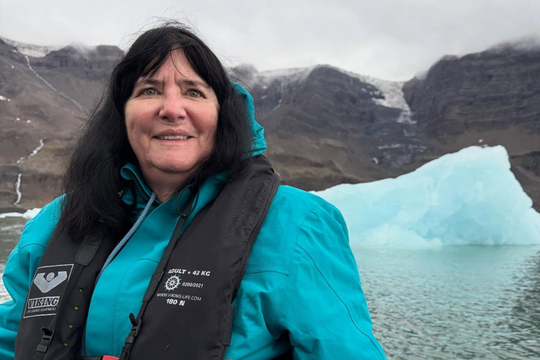
By Meredith Calloway, Chief Membership Development Specialist
So many career-change stories start from necessity: a layoff, a health scare, a financial cliff that finally pushes someone to do the thing they'd always wanted. But we rarely get to see what a second career looks like when nobody is forcing the decision, when a person could genuinely keep doing exactly what they were already doing, or nothing at all, and chose to build something new anyway.
When I invited Joan McGee Qualls, owner of Tasteful Voyages and Travel MBA alum, to join me on The Travel Business Unpacked podcast, I wanted to talk about something that sets her apart from a lot of our advisors. Though this is a second career for Joan, it wasn’t something she did out of need, but out of want.
Before travel, she spent nearly 30 years in healthcare finance, eventually leading process improvement work and training staff through six hospital system implementations. After a divorce, she retired in her mid-50s, remarried, and moved from Chicago to California. And after a couple of years of doing nothing, she started to feel she should be doing something. A chance conversation with a cruise consultant she met in an airport lounge turned into what she calls her light-bulb moment: "How do I get to do what you're doing?" That was ten years ago, when the Travel MBA program was brand new, and she has since fallen in love with this business.
Because her second career was built on choice rather than necessity, and she didn’t have to replace an income or cover a mortgage payment with her commissions, Joan doesn't measure success the way most advisors do. Her favorite stories weren't the most luxurious trips she'd booked, but the ones that were the most special in other ways. She talked about arranging an in-destination photo shoot for friends with modest budgets, and a trip to South Africa and Zimbabwe with girlfriends that she called the trip of a lifetime, not because of what it cost, but because of how it felt to be there.
However, a second career built entirely on choice doesn't make you immune to doubt. About three years ago, Joan admitted to another advisor that she wasn't sure this was for her anymore. That's the voice of fear talking, and I think so many of us know exactly what that sounds like. But it wasn’t a pep talk that helped her overcome that feeling; it was leaning on her community. That advisor didn't try to convince her that the doubt was wrong; instead, she confessed that she'd felt the same way herself. Sometimes the most powerful thing a strong community can do isn't to fix the fear, but to make sure you're never sitting with it alone. Joan came away from that conversation steadier, and since then, her business has grown roughly 50 percent year over year, on a schedule of about 30 hours a week.
I hear from so many people who are considering a second career in travel but worry that wanting it versus needing it isn’t a strong enough foundation for success. Joan's story shows that it is, and that it often shapes a healthier business because you get to define what success looks like instead of inheriting someone else's version of it.
If you love hearing stories like Joan's, tune into The Travel Business Unpacked podcast! Each episode dives deep into the real stories, practical strategies, and transformational moments that turn travel dreams into thriving careers. Listen and subscribe on Spotify and Apple Podcasts, and check out Joan's full episode here.
FAQs:
Can you become a travel advisor while keeping a full-timejob?
Yes. Many advisors ease into the business part-time while maintaining otherincome, gradually increasing their hours as their client base grows. Programslike the Travel MBA are structured over a year specifically to accommodate thiskind of gradual transition.
What skills from a previous career are useful as a traveladvisor?
Skills like project management, process improvement, client relationshipmanagement, and problem-solving under pressure translate directly into runninga travel advisory business. The technical side of booking travel is often theeasiest part to learn; the harder, more valuable skills tend to be onesadvisors already bring from prior careers.
Is it too late to become a travel advisor if I'm changingcareers later in life?
No — many successful travel advisors enter the industry as a second careerafter decades in a different field. Skills like project management, clientrelations, and process improvement transfer directly, and structured onboardingprograms like GTN's Travel MBA are specifically designed to fill in theindustry-specific knowledge a new advisor needs.